Holy Land
Angra
1996
Rankings
Why This Album Matters
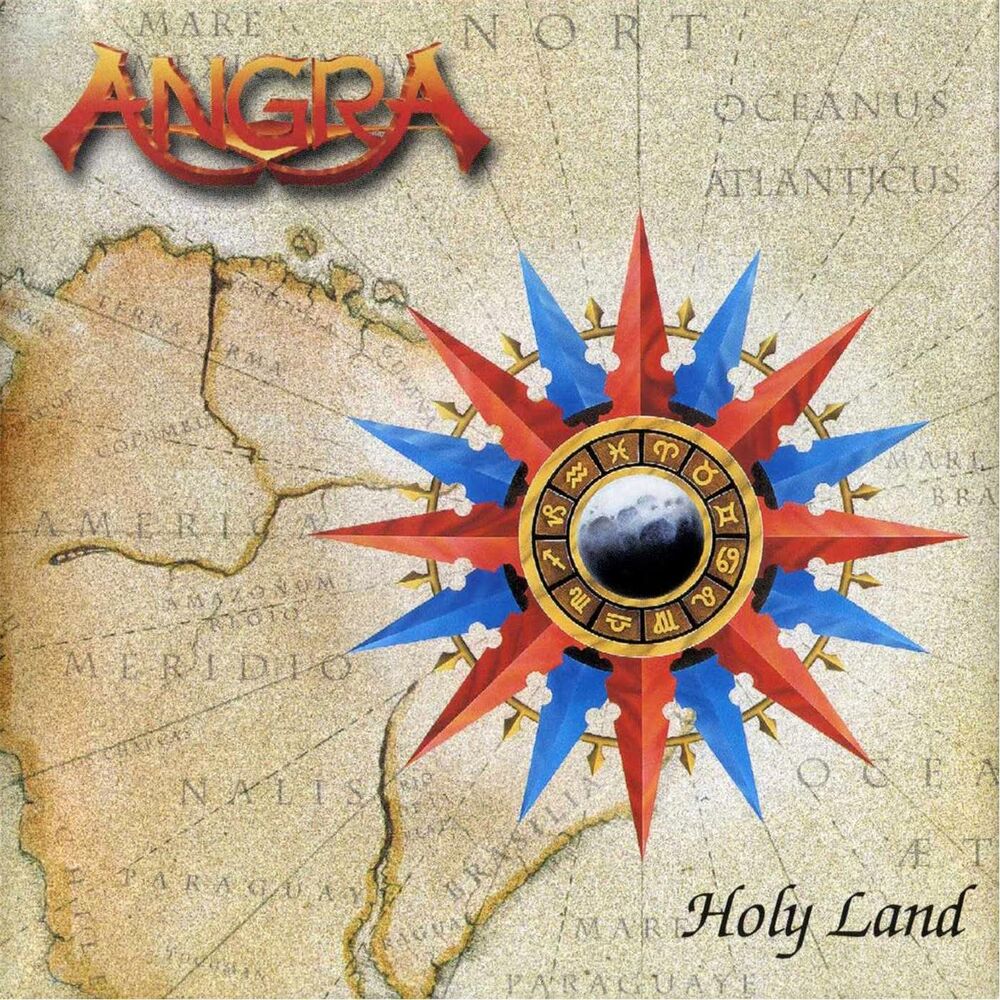
Holy Land, released in 1996 by Angra, is a seminal album that transcended the boundaries of traditional heavy metal, solidifying the band as one of the most innovative in the Brazilian music scene. The album is a bold fusion of power metal, progressive metal, and rich elements of classical music and Afro-Brazilian rhythms, creating a distinctive and unprecedented sound identity at the time. This conceptual work, centred on the theme of Brazil's discovery in the 16th century from a European perspective, not only narrates a crucial part of history, but also explores the cultural complexities and resulting clashes. Angra's ability to intertwine intense melodies with Brazil's vibrant musicality resulted in a work of great power, intensity and beauty, which captivates listeners far beyond the metal genre. Considered by many to be a masterpiece and a watershed album, Holy Land is an essential listen for understanding the evolution of melodic and progressive metal with a genuinely Brazilian signature.
Context
The album Holy Land arrived in March 1996, succeeding the acclaimed debut Angels Cry (1993), which had already gained significant recognition in Europe and, especially, in Japan. With its classic line-up comprising Andre Matos (vocals), Rafael Bittencourt (guitar), Kiko Loureiro (guitar), Luis Mariutti (bass) and Ricardo Confessori (drums), Angra already had a solid foundation in melodic metal, but sought to expand their artistic horizons. The conception of Holy Land took place in 1995, over a period of approximately four months, on a farm in the city of Tapiraí, São Paulo. This isolated environment and direct contact with nature provided the band with the freedom and focus needed to develop the compositions. It was in this context that Brazilian influences began to emerge naturally in the new songs, directing the album towards the cultural and historical theme that would consecrate it.
Recording
The production of Holy Land was helmed by the duo Charlie Bauerfeind and Sascha Paeth, names already recognised in the metal universe, with Bauerfeind having also worked on the band's previous album. The recordings took place between 1995 and 1996 in various studios in Germany, including Hansen Studio in Hamburg, Big House Studios in Hannover, HG Studio in Wolfsburg and Vox Klangstudio in Bendestorf, where vocals, piano, and organ were recorded. Percussive elements, choirs, acoustic bass, viola and flute, which significantly contributed to the album's Brazilian sound, were recorded at Djembe Studio in São Paulo, Brazil, between August and October 1995. The final mixing, carried out by Charlie Bauerfeind at Vox Klangstudio in January 1996, combined analogue tape recording with emerging digital techniques of the time, resulting in a rich and detailed sound. Sascha Paeth was also fundamental in keyboard programming and orchestral arrangements.
Songs
Holy Land is a conceptual work that delves into the process of Brazil's colonisation, addressing the fascination and violence of this cultural encounter, the country's natural beauty and the scars left by history. The opener, "Crossing", is an instrumental vignette that reproduces a mass by the Italian Giovanni Pierluigi da Palestrina, followed by the power of "Nothing to Say", an immediate band classic. The epic "Carolina IV", over ten minutes long, is one of the great highlights, starting with percussions that evoke maracatu and featuring a flute solo that quotes Hermeto Pascoal's theme "Bebê". The title track "Holy Land", authored by Andre Matos, deepens the melodic miscegenation, uniting native Brazilian, European, and African influences, and reflects on the consequences of colonisation. "The Shaman" balances heaviness and tribal elements, with speeches and sounds extracted from the album "Música Popular do Norte nº4". The ballad "Make Believe", composed by Rafael Bittencourt, became a hit and explores the loss of innocence and indigenous disillusionment in the face of the colonisers' intentions. "Deep Blue" muses on the immensity of the ocean and the dangers of navigation, with a beautiful ceremonial chant and Gregorian chant passages. The album concludes with the intimate "Lullaby for Lucifer", an acoustic song with guitar and voice, incorporating nature sounds and closing the narrative with a reflection on the costs and consequences of this journey.
Legacy
Holy Land consolidated Angra as a powerhouse of heavy metal, repeating the commercial success of its predecessor and achieving gold certification in Japan with one hundred thousand copies sold. The album was widely acclaimed by critics, often considered a masterpiece of national metal and a landmark in the power metal genre. Its relevance is such that it consistently features on lists of the most important albums in the history of Brazilian metal. Beyond its sales and critical success, Holy Land marked a turning point in Angra's identity, as it ceased to be merely a promise and became a band with singular artistic ambition. The album profoundly influenced a generation of musicians and listeners, helping to integrate the roots of Brazilian music into rock and metal. The music video for "Make Believe" was nominated for the 1996 VMB, contributing to the expansion of the band's audience. Its legacy continues, inspiring new generations of Brazilian artists and maintaining Holy Land as one of the most relevant albums in Angra's discography and in global metal.
Tracks
Credits
Angra
Andre Matos
Andre Matos, Sascha Paeth
Ricardo Confessori
Antonio Pirani
Charlie Bauerfeind, Sascha Paeth
John L. Newman
Giovanni Pierluigi da Palestrina
Andre Matos
Tuto Ferraz
Pixu Flores
The Farrambamba Vocal Group
Mônica Thiele
Reginaldo Gomes
Celeste Gattai
Naomi Munakata
Tuto Ferraz
Holger Stonjek
Ben Bischoff
Castora
Paulo Bento
Ricardo Kubala
Andre Matos
Luis Mariutti
Andre Matos
Sascha Paeth
Hugo Balslinke
Ingo C. Soares, Oliver Laudahn
Adriano Night, Claudinho, Claudião, Douglas, Filé, Gargamel, Marcão, Michael Berger, Mirko, Thomas Müller, Vespaciano Ayala
Leck Filho
Antonio Pirani, Mark Nowak
Alvaro "Huguinho", Everson, Junior Gaspari, Juréia, Mike Haymann
Ricardo Confessori
Kiko Loureiro, Rafael Bittencourt
Andre Matos
Kohlbecher & Partner
Charlie Bauerfeind
J. Alberto Torquato
Andre Matos, Rafael Bittencourt
Klang Konzepte
Fernando Pessoa
R. Limb Schnoor
Antonio Pirani
Nikolaj Georgiew
Podcasts
CMM · Crazy Metal Mind
Episódio originalmente publicado em 19/06/2016. No 251º episódio do Podcast mais Rock’n Roll da internet Rômulo Konzen, Christian Heit e Giuliano Ianarelli batem papo sobre o disco Holy Land do Angra. Trilha sonora do podcast (na ordem): *Angra - Make Believe *Angra - Nothing To Say *Angra - The Shaman *Angra - Crossing *Angra - Nothing To Say *Angra - Silence and Distance *Angra - Carolina IV
Rock na Mesa
Holy Land, do Angra, completa 30 anos em 2026, e para celebrar essa data especial, gravamos um episódio dedicado a revisitar uma das fases mais marcantes da história da banda.Em um papo de quase três horas, percorremos toda a chamada era Holy Land: desde o período das demos, passando por uma análise do próprio Holy Land, até chegar ao EP Freedom Call e ao registro ao vivo Holy Live.Além de falar s

Metalnews Podcast · metalnews
No último dia 23/03/2026, o Angra anunciou o fim do seu hiato e uma nova turnê comemorativa. São 30 anos de Holy Land e a partir do segundo semestre teremos uma turnê deste álbum fantástico.Mas que "hiato" é esse que dura sete meses? Bruno Antonucci e tibonev tem suas teorias da conspiração sobre o fim do hiato e a saída de Fabio Lione do Angra.
Videos
What if Holy Land Was a Bossa Nova Album? (Angra)
DreamixAI
Angra - Holy Land Album Reaction/Review!! Pt. 3 + Album Discussion!
Aetherial Gamer
Angra - Holy Land Album Reaction/Review!! Pt. 2
Aetherial Gamer
ANGRA: ANÁLISE FAIXA A FAIXA DO HOLY LAND | TUPFS RESENHA #08
Tomar Uma
Angra Holy Land Album Review | Half Hour Of Power
Three Guys and a Mic
ANGRA - Holy Land (Resenha Brutal) - VINNIE ESPECIAL TOMBOS MG
Wagão Autoral
Analyses
Holy Land – Wikipedia
Wikipedia, the free encyclopaedia
Holy Land é o segundo álbum da banda brasileira de heavy metal Angra. Ele é um álbum conceitual cujo tema é centrado nas terras brasileiras da época de sua descoberta no século 16, sob uma perspectiva europeia, como ilustrado na arte que acompanha o disco do álbum. Quando totalmente aberto, o encarte da capa revela ser um antigo mapa-mundi. Após adotar uma sonoridade mais europeia em seu álbum de estreia, Angels Cry, devido à influência do produtor alemão Charlie Bauerfeind, o Holy Land assume u
Angra - Holy Land - Album Review - RevelationZ
revelationz.net
Angra's Holy land was their second album and it's still my favorite. After the impressive debut, the band developed big time and here they have expanded their sound, the songwriting is more focused and they bring in new native elements, which give the album a unique atmosphere.
Angra - Holy Land review by notrobinson9 - Album of The Year
albumoftheyear.org
Holy Land seeks to fix that by incorporating plenty of musical influences from Angra's homeland of Brazil. Those touches certainly make this a more distinct and interesting listen, hell a good portion of this album isn't even metal, but it still all works together well.
Angra - Holy Land (album review ) | Sputnikmusic
sputnikmusic.com
The year was 1996 and São-Paulo-based Angra, although having released a single full-length album, had already achieved significant popularity in the underworld of Power Metal, even counting with a growing fan base in Japan. Their debut album, Angels Cry, consisted of relentless, unique Power Metal with Progressive and Classical influences. Kiko Loureiro and Rafael Bittencourt's technical ...
Angra em Holy Land (1996): o disco em que o Brasil reinventou o power metal
collectorsroom.com.br
At the centre of it all is Andre Matos's voice. His theatrical interpretation and impressive range help unify the album, even when it flirts with excess. It is a performance that might sound excessive at first, but proves essential to the work's identity.