A Página do Relâmpago Elétrico
Beto Guedes
1977

Rankings
Why This Album Matters
Released in 1977, A Página do Relâmpago Elétrico marks Beto Guedes' solo debut and represents a significant step forward in his career, solidifying him as one of the most distinctive voices in Brazilian Popular Music. The album is a sonic mosaic that interweaves the richness of MPB with elements of folk and progressive rock, rural rock, psychedelia, and choro, reflecting the plurality and innovation that characterise the artist from Minas Gerais. Its unique sound and elaborate compositions position it as a fundamental work in the Brazilian music scene.
Context
Beto Guedes, born in Montes Claros, Minas Gerais, was influenced by music from an early age, inheriting the talent of his father, Godofredo Guedes, a multi-instrumentalist and composer. Before his solo release, Beto was already a prominent figure in the effervescent music scene of Minas Gerais, having actively participated in the legendary Clube da Esquina. He contributed to the albums Clube da Esquina I and II and stood out for a remarkable duet with Milton Nascimento on the song "Fé Cega, Faca Amolada", from the album Minas, which already signalled his extraordinary vocal and compositional talent. The release of A Página do Relâmpago Elétrico occurred during a period of political transition in Brazil, known as the 'abertura', where MPB played a crucial role as a vehicle for expressing the hopes and anxieties of a society searching for new directions, making the album a reflection of that time.
Recording
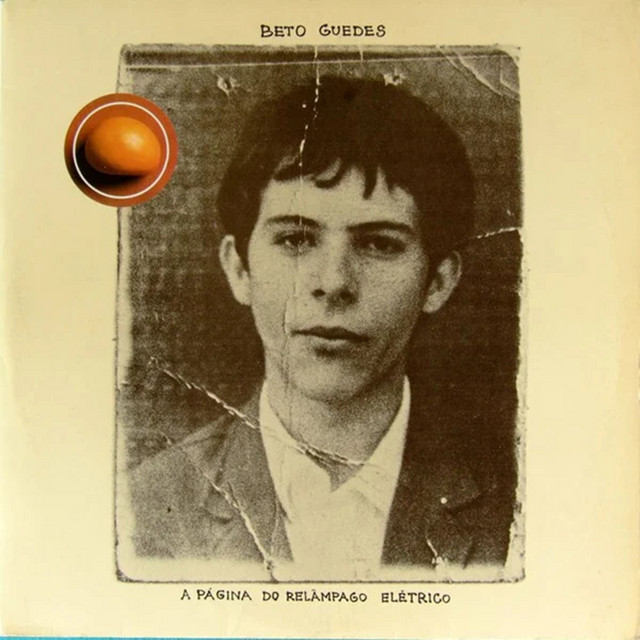
The production of A Página do Relâmpago Elétrico was overseen by Ronaldo Bastos, with the collaboration of Toninho Horta as associate producer, ensuring a refined and cohesive sound. The album featured the participation of various talents from the Clube da Esquina, such as Toninho Horta himself on bass and acoustic guitar, Flávio Venturini on electric piano and organ, Robertinho Silva on drums, and Vermelho on keyboards and backing vocals, alongside other musicians who enriched the arrangements. The orchestrations and conducting were conceived by Toninho Horta, lending a grand dimension to the songs, while the artistic direction was handled by Milton Miranda and the mixing by Nivaldo Duarte. The striking and iconic cover art was developed by Cafi and Ronaldo Bastos, elements that combined to create a complete auditory and visual experience.
Songs
The repertoire of A Página do Relâmpago Elétrico consists of ten tracks, predominantly credited to Beto Guedes and Ronaldo Bastos. The title track, which opens the album, is a complex rock song with progressive influences and evocative lyrics by Ronaldo Bastos, inspired by Guedes' passion for aviation and the idea of 'crossing borders' and 'untangling the knot of the five senses' to break free. "Maria Solidária", by Milton Nascimento and Fernando Brant, bears the unmistakable mark of the Clube da Esquina, blending baião, tropicalismo, and bossa nova in an emotional tribute. The album also stands out for its instrumental tracks such as "Chapéu de Sol", a collaboration with Flávio Venturini, which explores psychedelic layers and synthesisers, and "Bandolim", where Beto Guedes showcases his mastery of the instrument. "Nascente", by Flávio Venturini and Murilo Antunes, is a heart-wrenchingly beautiful song about dawn and a beloved woman, featuring essential piano and drums played by Beto Guedes himself. The album concludes with "Belo Horizonte", an instrumental choro by Godofredo Guedes, Beto's father, which honours the capital of Minas Gerais and the state, featuring Abel Ferreira on clarinet and Paulo Guimarães on flute.

The first time the name of the Minas Gerais native from Montes Claros, Alberto de Castro Guedes, or Beto Guedes, was heard on the major MPB circuit was in 1970.
Tárik de Souza · 300 Discos Importantes
Legacy
Since its release, A Página do Relâmpago Elétrico has been recognised as one of the most important works in Brazilian pop culture. In a survey conducted by the podcast Discoteca Básica with 162 music specialists, the album was ranked as the 112th best, and the Allmusic website awarded it a rating of 4.5 out of 5 stars. Many critics consider it one of the best Brazilian albums of all time, praising its authenticity and Beto Guedes' ability to imprint a unique vocal and interpretive personality. The album's lasting influence is so profound that, in 2023, a book titled “Leia esta canção: Beto Guedes” was released by Editora Museu Clube da Esquina, entirely based on the work. The album not only propelled Beto Guedes' solo career but also immortalised him as an artist capable of uniting the regional and the universal, continuing to move and inspire generations of listeners.
Tracks
Credits
Milton Miranda
Toninho Horta
Mariozinho Rocha
Ronaldo Bastos
Ladimar
Osmar Furtado
Nivaldo Duarte
Dacy Rodrigues, Roberto Castro, Toninho
Cafi
Cafi, Ronaldo Bastos
Gilberto De Abreu
Podcasts
Sons e Histórias · Daniel Queiroz
Um álbum que é pura magia, poesia e invenção.No episódio 94 do Sons e Histórias, mergulhamos em “A Página do Relâmpago Elétrico” (1977), o álbum de estreia de Beto Guedes, um dos pilares do Clube da Esquina.Com melodias solares, arranjos sofisticados e letras que misturam lirismo e existencialismo, Beto Guedes construiu uma obra-prima que dialoga com Milton Nascimento, Lô Borges e Fernando Brant,
Videos
BETO GUEDES E O SENSACIONAL "A PÁGINA DO RELÂMPAGO ELÉTRICO" | ALBUM REVIEW
Som de Peso
Beto Guedes - A Página do Relâmpago Elétrico | Contracapa
Sala de Estar
Books
Os 500 Maiores Álbuns Brasileiros de Todos os Tempos
Ricardo Alexandre · 2022
The largest Brazilian music election ever conducted: 162 specialists, spanning journalists, critics, musicians, producers and podcasters, each nominated 50 essential albums, supported by a masterlist of more than 2,000 works. Led by Ricardo Alexandre with tabulation by Sérgio Jomori, it was published in December 2022 as a 200-page hardcover book with graphic design by Fernando Pires.

300 Discos Importantes da Música Brasileira
Charles Gavin, Tárik de Souza, Carlos Calado, Arthur Dapieve · 2008
Conceived by Titãs drummer and musical researcher Charles Gavin, the 434-page book brings together covers and reviews of albums released between 1929 and 2007. The texts were written by journalists Tárik de Souza, Arthur Dapieve and Carlos Calado.

Leia esta canção: Beto Guedes
Short stories, texts, and illustrations inspired by the debut album by musician and composer Beto Guedes, "A Página do Relâmpago Elétrico". Organised by Marina Ruivo. Au...
Analyses
A Página do Relâmpago Elétrico – Wikipedia
Wikipedia, the free encyclopaedia
Beto Guedes 'A Página do Relâmpago Elétrico' um Disco Conciso e Elegante
teoriacultural.com.br
In 1977, Beto made his solo debut with the emblematic and sensational 'A Página do Relâmpago Elétrico'. The record beautifully traverses the influences of Minas Gerais music, Tropicalismo, Bossa Nova, Progressive Rock and the psychedelia of The Beatles.
#1 - Beto Guedes - A Página do Relâmpago Elétrico (1977) - Ranking dos ...
pressenza.com
A página do relâmpago elétrico (1977), álbum de estreia de Beto Guedes, pode até não ser o melhor disco da música brasileira. Entretanto, eu o considero, definitivamente, como o melhor disco da música brasileira.
Beto Guedes - A Página do Relâmpago Elétrico
umcatalogo.substack.com
I tried to think of something I'd never heard or read to discuss Beto Guedes and A Página do Relâmpago Elétrico. It is necessary to start by saying there is something sacred about this album, his first solo flight post-Clube da Esquina, released in 1977.

(crítica - disco) Beto Guedes - A Página do Relâmpago Elétrico (1977 ...
materialmaterial.blogspot.com
But let the reader not be mistaken, for Beto Guedes is not merely a great instrumentalist, much less is he reduced to a kind of hitmaker, idolised by university students and last-minute hippies.