Cinema Transcendental
Caetano Veloso
1979

Rankings
Why This Album Matters
Cinema Transcendental, released in 1979, represents a fundamental milestone in Caetano Veloso's career, signalling a significant transition in his work after a period of more radical experimentation. The album marked Caetano's reunion with a wider audience and with critics, who welcomed him with enthusiasm after the mixed reception of previous works like Bicho and Muito (Dentro da Estrela Azulada). This 'sun-drenched' album, filled with classics, paved the way for the sound that would dominate the artist's career in the following decade. With a rich fusion of styles embracing pop, bossa nova, samba and jazz, Cinema Transcendental stands out for its imaginative arrangements and captivating melodies, which underpin lyrics of profound lyrical power. Tárik de Souza, from Jornal do Brasil, captured the essence of this turning point by stating that, "tired of being modern, in the avant-garde sense of the term, Caetano Veloso, following the lesson of the poet Carlos Drummond, preferred to eternalise himself. To shorten the path, he soon decided to sing transcendence", underscoring the pursuit of a more universal and timeless beauty.

The success of tracks like “Lua de São Jorge”, “Badauê”, “Menino do Rio”, “Beleza Pura”, “Cajuína”, “Oração ao Tempo” and “Trilhos Urbanos” marked a turning point in Caetano’s career.
Antônio do Amaral Rocha · Rolling Stone Brasil
Context
The release of Cinema Transcendental in 1979 occurred at a time of profound transformations in Brazil. The country was undergoing the process of 'political opening' after years of military dictatorship, a period marked by censorship and cultural repression. The Amnesty Law, approved in August of that year, was a watershed moment, allowing the return of exiles and marking the beginning of redemocratisation. Caetano Veloso, himself an exile from the military regime, was navigating a challenging period in his career post-return to Brazil. After the Tropicalista effervescence and introspective albums during his exile, he sought new sonic paths. His albums from the mid-70s, such as Araçá Azul (1973), Bicho (1977) and Muito (Dentro da Estrela Azulada) (1978), although artistically relevant, at times flirted with experimentalism and did not achieve the same critical and public resonance as earlier or later works. Cinema Transcendental thus represented not only a commercial success but a reconciliation with the press and a warmer embrace from the wider public.
Recording
The album Cinema Transcendental was recorded between July and September 1979, at Polygram studios in Rio de Janeiro. Production was handled by Caetano Veloso himself, demonstrating his artistic control over the project. The basic arrangements were developed in collaboration with A Outra Banda da Terra, his backing group at the time, who actively participated in the album's sound conception. A Outra Banda da Terra consisted of Tomás Improta on keyboards, Arnaldo Brandão on bass, Vinicius Cantuária on drums and Edu (Bolão) Gonçalves on percussion. The album featured special guest appearances by important names such as Dominguinhos, who brought his unmistakable accordion to tracks like "Oração ao Tempo" and "Cajuína", Perinho Santana, Tony Costa and Paulão Zdanowski. The arrangements stood out for their blend of acoustic and electric elements, utilising acoustic guitar (both in its natural and modified form), electric guitar, keyboard and drums on the pop songs, while the more intimate and regional tracks explored the acoustic guitar without effects, accompanied by percussion and instruments such as the accordion or bamboo flute. The iconic cover photograph, showing Caetano from behind looking out at the sea and sky, was not initially conceived for the album, but was ultimately chosen by the artist because it aligned perfectly with the idea and title of Cinema Transcendental, and also with the lyrics of "Lua de São Jorge".
Songs
Cinema Transcendental is a collection of songs that became MPB classics, with "Lua de São Jorge", "Oração ao Tempo" and "Beleza Pura" emerging as big hits. "Lua de São Jorge" opens the album with an atmosphere of celebration, with its swinging melody and lyrics that salute the moon as a symbol of Brazilian identity. "Oração ao Tempo" is notable for its singular genesis, where Caetano composed the melody after writing the stanzas as a poem, repeating the musical structure for all parts, resulting in one of the most re-recorded songs in his repertoire. "Beleza Pura" was a hit even before it was recorded by Caetano, driven by the group A Cor do Som, and on the album, it gained an arrangement influenced by ijexá. Other gems include "Menino do Rio", equally popular and interpreted by various artists, the intense "Vampiro" by Jorge Mautner, and the poetic "Elegia", with verses by Augusto de Campos. The album flows seamlessly between pop formats and more experimental, regional or intimate moments, exemplified by "Cajuína" and "Badauê", the latter a tribute to master Môa do Catendê. Caetano's ability to harmonise poetry, melody and arrangement with simplicity and lyrical depth is a constant throughout the album.
Legacy
Cinema Transcendental established itself as one of the most important albums in Brazilian music, being consistently recognised in various prestigious lists. It features at number 66 on Rolling Stone Brasil's list of the "100 Greatest Albums of Brazilian Music" and reached 68th place in a poll of 162 music specialists conducted by the Discoteca Básica podcast. The album represented a true "turnaround in sales" for Caetano Veloso, significantly expanding his audience and commercial acceptance after a period of more complex reception. Specialist critics, such as Tárik de Souza, were mostly positive, praising the maturity and poetic transcendence achieved by the artist. More than a commercial and critical success, Cinema Transcendental cemented Caetano's identity in the post-exile era and contributed to redefining the direction of MPB in the late 70s, with many of its songs being widely re-recorded and remaining alive in the repertoire of various artists and in the popular imagination. The album's success also spurred a period of more regular tours for Caetano.
Tracks
Credits
A Outra Banda Da Terra, Caetano Veloso
Caetano Veloso
Lucia Turnbull, Marizinha, Paulo Zdanowski, Regina A.S. Souza, Solange, Viviane Godoi
Caetano Veloso
Arnaldo Brandão
Vinicius Cantuária
Tomas Improta
Carlos Eduardo Gonçalves
Jairo Pires, Luis Cláudio Coutinho
Luis Cláudio Coutinho, Paulinho Chocolate
Mariano Martins
Aldo Luiz
Robert Feinberg
Podcasts
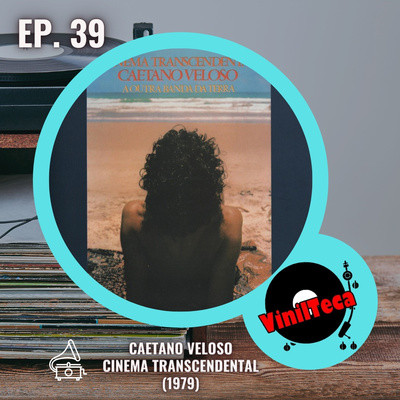
Vinilteca · José Ono Junior e Guilherme Colpani
Pra fechar sua trajetória musical nos anos 70, Caetano Veloso lançou ao lado dos músicos da Outra Banda da Terra, o disco "Cinema Transcendental", com uma sonoridade tranquila e regional. Se tornou um dos melhores álbuns da sua discografia, possuindo sucessos inesquecíveis como "Cajuína", "Trilhos urbanos" e "Oração ao tempo". A Vinilteca é um projeto que nasceu no YouTube em 2016 e migrou para o
Videos
Caetano Veloso – A História do Álbum Cinema Transcendental
Vinilteca
Films

Books

Cine Subaé
Caetano Veloso · 2024
A collection of Caetano Veloso's reviews and testimonies about the films that marked his career. As the album 'Cinema Transcendental' has cinema as its explicit theme, this book, written by the artist himself, offers a direct understanding of his references and thoughts on the seventh art, fundamental to understanding the album's concept.
Os 500 Maiores Álbuns Brasileiros de Todos os Tempos
Ricardo Alexandre · 2022
The largest Brazilian music election ever conducted: 162 specialists, spanning journalists, critics, musicians, producers and podcasters, each nominated 50 essential albums, supported by a masterlist of more than 2,000 works. Led by Ricardo Alexandre with tabulation by Sérgio Jomori, it was published in December 2022 as a 200-page hardcover book with graphic design by Fernando Pires.

Verdade tropical
Caetano Veloso · 1997
This is Caetano Veloso's definitive autobiography, where he narrates his personal and artistic trajectory, including his period of exile, the Tropicália movement, and his musical evolution. It offers crucial insights into the context and influences behind his albums, such as 'Cinema Transcendental'.
Analyses
Cinema Transcendental – Wikipedia
Wikipedia, the free encyclopaedia
Cinema Transcendental – The 100 Greatest Albums of Brazilian Music
Antônio do Amaral Rocha · Rolling Stone Brasil
The success of tracks like “Lua de São Jorge”, “Badauê”, “Menino do Rio”, “Beleza Pura”, “Cajuína”, “Oração ao Tempo” and “Trilhos Urbanos” marked a turning point in Caetano’s career.
Album: Cinema Transcendental. Artist/Band: Caetano Veloso. Year: 1979.
staimusic.com
Caetano Veloso is one of Brazil's most famous and innovative musicians, known for his unique blend of traditional Brazilian music with experimental rock and pop. His third album, Cinema Transcendental, released in 1979, remains a classic of the genre and is considered by many to be one of his best works. In this blog post, we will review the album, explore the artist's history and the music ...
vinylfanatics.com - Vinyl Record Reviews, News and Forum
vinylfanatics.com
There's something beautifully apt about Caetano Veloso titling his latest album Cinema Transcendental. At 79, the Brazilian master continues to approach music like a film auteur, crafting sonic landscapes that blur the boundaries between reality and reverie, between the intimate whisper and the cosmic declaration. This collection of ten tracks feels less like a conventional album and more like ...

1979 - Cinema Transcendental - Caetano Veloso - Blogger
caetanoefoda.blogspot.com
Cinema Transcendental was released in November 1979 and is Caetano Veloso's second album with A Outra Banda da Terra. Following an avalanche of criticism since Bicho and Muito, there was greater acceptance for the album, which begins with a smile from Caetano as he sings Lua de São Jorge.