Qualquer Coisa
Caetano Veloso
1975

Rankings
Why This Album Matters
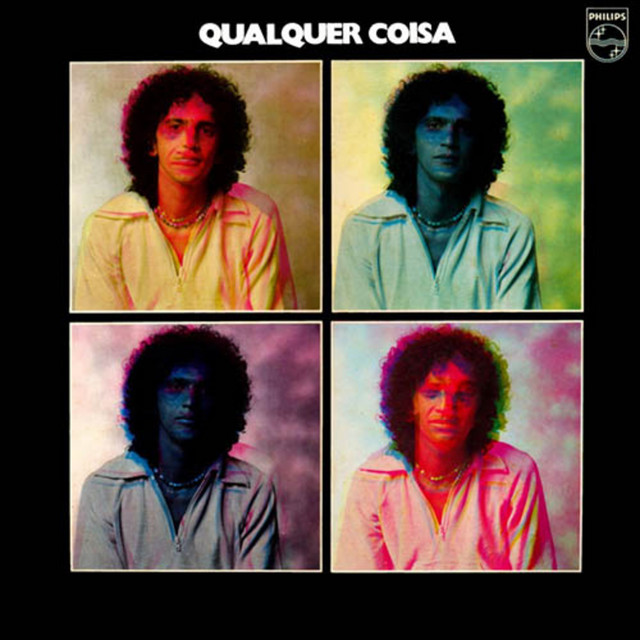
Qualquer Coisa is a studio album by Caetano Veloso, released in July 1975, which stands out for its proposition of "anything goes, drums, chaos" in contrast to the album Jóia, released simultaneously. Its cover, a collage of four photos of the artist, makes a clear allusion to the aesthetic of Let It Be by The Beatles and to Andy Warhol's screen prints, indicating an artistic and visually provocative intention. The album incorporates three re-recordings of songs by the legendary English band, marking an explicit connection with the international pop universe. This work represents a more relaxed and experimental facet of Caetano's output during that period, with a more comprehensive sound than its contemporary Jóia. The diversity of compositions and interpretations present on the album, which includes not only original tracks but also classics by other artists, consolidates Qualquer Coisa as a singular point of interest in the artist's discography.

Here, we almost always hear Caetano, his guitar, some backing vocals, some percussion, a little flute here, a keyboard there: all discreet, lyrical and subtle.
Alexandre Matias · Rolling Stone Brasil
Context
The album Qualquer Coisa was conceived and released during a period of intense creativity for Caetano Veloso, following the album Araçá Azul. Initially, the idea was for it to be a double album, together with Jóia, but Philips Records discarded this possibility due to the weaker-than-expected commercial performance of Caetano's previous work. The decision to separate the material into two distinct albums reflects a label strategy and an artistic distinction conceived by Caetano himself, who viewed Jóia as a collection of "small, well-finished pieces" and Qualquer Coisa as a space for greater freedom and sonic experimentation.
Recording
The recording of Qualquer Coisa was marked by the pursuit of a freer and, according to Caetano himself, "relaxed" sound, with the inclusion of drums and other elements. The artist commented on the title track that, despite liking the composition, he felt that "in the recording the song became constrained". The production of the album was part of a larger project which, due to the abundance of material, would originally have been a double album. However, by decision of Philips Records, following the low sales performance of the previous album Araçá Azul, the material was divided, resulting in the separate releases of Qualquer Coisa and Jóia.
Songs
The repertoire of Qualquer Coisa is notably eclectic, blending Caetano Veloso's own compositions with re-recordings of international classics and other great names in Brazilian music. Among the standout tracks, the album features three interpretations of Beatles songs: "Eleanor Rigby", "For No One" and "Lady Madonna". In addition to Caetano's compositions such as the title track "Qualquer Coisa" and "Da Maior Importância", the album includes "Samba e Amor" by Chico Buarque, "Madrugada e Amor" by José Messias, "Jorge de Capadócia" by Jorge Ben, "Drume Negrinha" (Drume negrita) by Ernesto Grenet, and "La flor de la canela" by Chabuca Granda. Caetano mentioned that Roberto Carlos had reportedly shown interest in recording the song "Qualquer Coisa", praising the professional potential of the King's interpretation.
Legacy
Despite the albums being separated for commercial reasons, Qualquer Coisa outsold Jóia, reaching around 60,000 copies, compared to 30,000 for the other work. This repercussion surprised Caetano Veloso himself, who observed how the title track "Qualquer Coisa", with its abstract lyrics and references to a Rogério Sganzerla film, was widely embraced by the public. The commercial success of the album, which was re-released on CD in 1991, demonstrates its ability to communicate with a vast audience, solidifying its place in Caetano's discography and in MPB.
Tracks
Credits
Caetano Veloso, Perinho Albuquerque
Jairo Gualberto
João Moreira, Luigi Hoffer
Joaquim Figueira
João Moreira
José Guilherme, Paulo Sergio
Caetano Veloso, João Castrioto, Rogério Duarte
Podcasts
O Abertinho - Ler é um ato subversivo · Rogério Mattos
Muita gente canta "Qualquer Coisa" do Caetano Veloso. Quase ninguém sabe que ela nasceu de um filme.Em 1970, Sganzerla, Bressane e Helena Ignez fundam a Belair — produtora clandestina que durou 4 meses e fez uns 10 filmes. Quando o cerco aperta, vão pro exílio. Em Londres, encontram Caetano e Gil. Assistem juntos a "Sem Essa Aranha". Caetano surta. Quando se recupera, escreve a música."Não se avex
O episódio de número 30 foi especial, o primeiro transmitido ao vivo pelo Facebook, com participação da audiência. O programa explorou a vida do mais expoente músico do movimento cultural Tropicália, a partir do seu disco de 1975, que é repleto de excelentes versões de canções. De Beatles a Chico Buarque, Caetano dá sua cara. Lado A Live do Facebook; Ricardo Boechat; Comentários dos ouvintes; Deli
Videos
Dicas Musicais: Análise de "Qualquer coisa", de Caetano Veloso
Rosana Marques Cantora
Films

Books
Os 500 Maiores Álbuns Brasileiros de Todos os Tempos
Ricardo Alexandre · 2022
The largest Brazilian music election ever conducted: 162 specialists, spanning journalists, critics, musicians, producers and podcasters, each nominated 50 essential albums, supported by a masterlist of more than 2,000 works. Led by Ricardo Alexandre with tabulation by Sérgio Jomori, it was published in December 2022 as a 200-page hardcover book with graphic design by Fernando Pires.

Verdade tropical
Caetano Veloso · 1997
A seminal autobiography by Caetano Veloso, 'Verdade Tropical' (Tropical Truth) narrates the history of the Tropicalista movement and the artist's trajectory, including his exile and return. It is fundamental for understanding the historical, political, and personal context that shaped the creation of his albums, such as 'Qualquer Coisa', released in 1975 after his return to Brazil.
A Imagem do Som de Caetano Veloso
A Imagem do Som de Caetano Veloso
Caetano Veloso
Although the publication year is unknown, this book by Caetano Veloso himself, titled 'A Imagem do Som' (The Image of Sound), suggests a collection of his writings, essays, or reflections on his musical work, his sound aesthetic, and the process of creating his albums. It is a valuable primary source for understanding the artist's vision of his own music.
Analyses
Qualquer Coisa – Wikipedia
Wikipedia, the free encyclopaedia
Qualquer Coisa – The 100 Greatest Albums of Brazilian Music
Alexandre Matias · Rolling Stone Brasil
Here, we almost always hear Caetano, his guitar, some backing vocals, some percussion, a little flute here, a keyboard there: all discreet, lyrical and subtle.
Album: Qualquer coisa. Artist/Band: Caetano Veloso. Year: 1975.
staimusic.com
One of his most interesting albums is Qualquer coisa, released in 1975. In this critical review, we'll explore the history of the artist, the music genre of the album, the best songs of the album, the most innovative parts, and a critique of the album. Caetano Veloso was born in Salvador, Brazil in 1942.

Musicology: Caetano Veloso - Qualquer Coisa 1975 - Blogger
madshoesmusicology.blogspot.com
On Qualquer Coisa, Caetano Veloso still wasn't the superstar he became in the '80s when he turned himself into a mainstream pop artist. This album sounds underground in its voice/violão renditions, parsimony in the arrangements, and absence of luxury effects or electronics -- in other words, the focus is on Veloso 's guitar, voice, melodies ...

"Qualquer Coisa" (Philips, 1975), Caetano Veloso
discosessenciais.blogspot.com
Joia followed a line of simplicity and introspection, while Qualquer Coisa embraced improvisation, without losing artistic rigour. The result was an album that flirts with deconstruction, but maintains a central axis: the celebration of creative freedom.