O Papa É Pop
Engenheiros Do Hawaii
1990
Rankings
Why This Album Matters
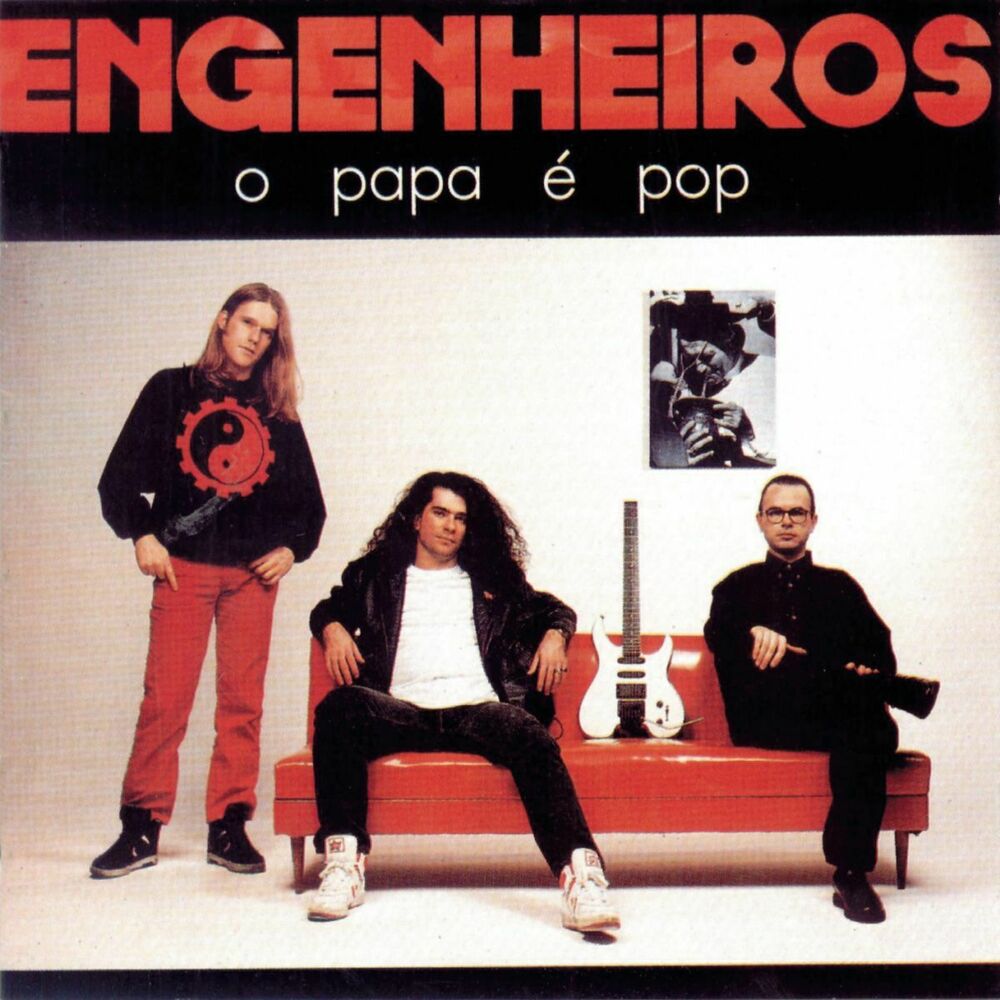
Released in September 1990, O Papa É Pop represents a fundamental milestone in the career of Engenheiros do Hawaii and in the history of Brazilian rock of the decade. This album not only consolidated the band as one of the biggest of its time, but also signalled a daring aesthetic and sonic shift. Marking the group's first self-produced work, the album unprecedentedly and radically embraced electronic sounds, incorporating synthesizers, sequencers, drum machines, and MIDI foot controllers, challenging the perception of the fine line between art and entertainment in the musical landscape of the time.
Context
The release of O Papa É Pop occurred during a period of intense turbulence in Brazil, marked by the severe economic crisis resulting from the confiscation of assets under the Collor Plan. Furthermore, the musical scene witnessed the emergence of new sertaneja music, which rapidly gained ground and competed for the preference of young people and, consequently, radio chart positions. In this challenging environment, the national rock movement of the 80s began to show signs of exhaustion and declining sales. Internally, the band had already been experimenting with electronic timbres on tracks from their previous album, Alívio Imediato, driven by Humberto Gessinger's reflections on the opposition between art and entertainment, seeking in pop sounds and instruments a way to question established boundaries.
Recording
The recording sessions for O Papa É Pop took place in July and August 1990 at BMG studios in Rio de Janeiro, marking the band's first recording in the city where its members had resided since 1988. This album was pioneering in the trajectory of Engenheiros do Hawaii, being the first in a sequence of three self-produced records, granting the band unprecedented creative control. Motivated by the search for new timbres, the musicians invested significantly in equipment: the band acquired a Dynacord drum machine, and Augusto Licks travelled to New York to acquire a new Steinberger guitar, an Alesis HR-16 drum machine, a Dimension-C chorus pedal, and an Elka MIDI foot controller. The recording process was meticulous and fragmented into three shifts, with Carlos Maltz recording drums in the morning, Augusto Licks guitars and keyboards at night, and Humberto Gessinger dedicating afternoons to bass and keyboards, allowing for meetings for discussions and refinements. This approach also implied the separation of bass and drum recording, as the latter was predominantly programmed on the drum machine.
Songs
The album stands out for a richness of arrangements and compositions, blending a rock sensibility with electronic innovations and cultural references. The opening with "O Exército de um Homem Só I", followed by its second part, reveals lyrical depth inspired by the work of Moacyr Scliar and dedicated to Mathias Rust, with elaborate instrumentation that includes citations to "Canção do Expedicionário". The great commercial success "Era um Garoto que como Eu Amava os Beatles e os Rolling Stones" is a striking reinterpretation, where Augusto Licks creates an innovative solo, a melodic collage of national anthems and jingles, recorded with a two-channel technique to simulate a guitar duel. Tracks like "Nunca mais Poder" explore philosophical themes inspired by Carlos Drummond de Andrade, with arrangements that nod to progressive rock.
Legacy
O Papa É Pop became Engenheiros do Hawaii's most commercially successful album, selling over 350,000 copies in the year of its release and achieving platinum certification. Such an achievement was notable, considering the economic crisis scenario and the rise of sertaneja music that dominated the charts at the time, as well as the general decline of 80s national rock. The album's impact elevated the band from one of the biggest in national rock to the biggest in its year of release, resulting in numerous awards and a significant increase in media interest. Strong promotion featured four successful singles, including "O Exército de um Homem Só I", "O Papa É Pop", "Era um Garoto que como Eu Amava os Beatles e os Rolling Stones", and "Pra Ser Sincero", in addition to music videos that received high rotation on the newly created MTV Brasil.
Tracks
Credits
Engenheiros Do Hawaii
Augusto Licks, Humberto Gessinger
Cezar Delano, Cássio Araújo, Dalton Rieffel, Flavio Senna, Franklin Garrido, Mário Jorge, Ricardo Essucy, Ronaldo Lima
Podcasts
Vinilteca · José Ono Junior e Guilherme Colpani
Em 1990, o quarto disco do Engenheiros do Hawaii, "O Papa é pop", se tornou o mais vendido da banda, numa época de confisco de poupança e crise econômica no Brasil. O álbum trazia uma mudança na sonoridade da banda, que se mostrava mais próxima do rock progressivo e de um som mais acessível ao grande público. "O papa é pop" é um clássico do rock. A Vinilteca é um projeto que nasceu no YouTube em
CMM · Crazy Metal Mind
Episódio originalmente publicado em 09/12/2022. No 598º episódio do Podcast mais Rock’n Roll da internets Rômulo Konzen, Daniel Iserhard e Flávio Bandeira batem papo sobre o disco O Papa é Pop do Engenheiros do Hawaii. Trilha sonora do podcast (na ordem): *Engenheiros do Hawaii - Era um Garoto Que como Eu Amava os Beatles e os Rolling Stones *Engenheiros do Hawaii - A Violência Travestida Faz
Crazy Metal Mind
No 598º episódio do Podcast mais Rock’n Roll da internet Rômulo Metal, Daniel Iserhard e Flávio Bandeira batem papo sobre o maior clássico do Engenheiros do Hawaii, o disco O Papa é Pop, analisando faixa por faixa. O post PodCast #598 – Engenheiros do Hawaii: O Papa é Pop apareceu primeiro em Crazy Metal Mind.

Outras Frequências · Ronaldo do Carmo Fernandes
Um pouco sobre o disco de 1990 que a banda fez a produção e colocou o Engenheiros como uma das bandas mais importantes do cenário brasileiro.
Videos
"O PAPA É POP", dos ENGENHEIROS DO HAWAII (1990): feito por causa do Lenoel Brizola!
Júlio Ettore
"O PAPA É POP" critica a cultura POP e provoca a IGREJA CATÓLICA (Engenheiros do Hawaii)
Júlio Ettore
O PAPA É POP - Engenheiros do Hawaii. Ensaio banda.
Marcelo Borba
🎸 A História Por Trás de O Papa é Pop – Engenheiros do Hawaii no Topo do Rock!
Vinilteca
"O papa é pop": Um clássico dos Engenheiros do Hawaii | Disco | Alta Fidelidade
Alta Fidelidade
As curiosidades que vocês trouxeram sobre: "O PAPA É POP"! (Engenheiros do Hawaii)
Júlio Ettore
Books
Somos quem podemos ser
Gisele da Silva Souza · 2019
This book investigates the complete works of Engenheiros do Hawaii and the rise of the youth generation in the 1980s, discussing rock and the issues that concerned young people at that time. The research was developed from songs and an analysis of the covers of the group's 18 official albums, offering an in-depth analysis that will certainly cover the album 'O Papa É Pop'.
Infinita Highway
Alexandre Lucchese · 2016
This book chronicles the history and journey of one of Brazil's greatest rock bands, Engenheiros do Hawaii. The book details the band's origins, its formation, and the path that led them to stardom, an essential biography for understanding the context and creation of important albums such as 'O Papa É Pop'.
Analyses
O Papa É Pop – Wikipedia
Wikipedia, the free encyclopaedia
Crítica Engenheiros do Hawaii - O Papa é Pop (1990)
soumaispop.com.br
Released in September 1990, the band's fifth album and the biggest commercial success of Engenheiros do Hawaii's career, "O Papa é Pop" is an LP that embraces a new direction in the band's sound: electronic instrumentals, most notably, electronic drums.

"O Papa É Pop" (BMG/RCA), Engenheiros do Hawaii - Blogger
discosessenciais.blogspot.com
Released in October of that year, O Papa É Pop was a watershed in the career of the Gaúcho trio, both commercially and artistically. It was Engenheiros Do Hawaii's best-selling album, and artistically, it promoted a musical reorientation of the group.
O Papa é Pop (Engenheiros do Hawaii) - ithanara.substack.com
ithanara.substack.com
The intro to "O papa é pop" immediately makes it clear that this is going to be one of the songs with the most varied sounds, and I really like that about it. As it evolves, you start to realise that it talks about how little it takes for violence to happen, despite being super good vibes instrumentally.
Só me resta o Rock'n'Roll: Os 30 anos de "O Papa é Pop"
whiplash.net
Thirty years ago, the most important album of Engenheiros do Hawaii's career was released. On 1st October 1990, the album "O Papa é Pop", by the trio, was released...